
If you ship goods, knowing your incoterms is essential to understanding who is responsible for what in your supply chain. Read on to learn all about incoterms and how to choose the right one for your shipment.
Incoterms in layman’s terms: the incoterms guide for shipping goods
What are incoterms?
Transportation Incoterms (international terms of trade) are the standard contract terms used in sales contracts with importers/exporters. They are used to define the responsibility for the goods in the course of a shipment. In other words, they specify when responsibility for the goods is transferred from the supplier to the buyer. They also define who pays what costs for the goods and their transportation.
Types of incoterms
Free On Board (FOB), Ex-Works (EXW) and Free Carrier (FCA) are the most popular types of incoterms, but there is much to learn about these and other options. Which one is right for you depends on factors including the type of goods being shipped, your experience as a shipper and your relationship with your supplier. Most incoterms can be used for any mode of transportation. The exceptions are FOB, FAS, CFR and CIF, which are used for ocean freight only.
Incoterms for air transport
Incoterms commonly used for air shipments are as follows: Ex-Works (EXW), whereby the buyer assumes responsibility at the seller’s warehouse and is responsible for everything, including transportation and insurance. Carriage and Insurance Paid (CIP), whereby the seller is responsible for insurance. Carriage Paid to (CPT), whereby the seller delivers the goods and covers all fees involved in delivering the goods to the named destination. After delivery, the buyer assumes responsibility. Delivered Duty Paid (DDP), which imposes most of the obligations on the seller. He is responsible for all costs and risks of transportation, insurance and customs clearance. This is the only Incoterm that defines the seller as the importer of record at destination. Delivered At Place (DAP), whereby the seller covers the main transportation costs, but is not responsible for customs clearance.
Why are incoterms important?
Importers and exporters should consider which incoterms are most suitable for them before negotiating the sales contract. This can avoid unexpected costs and unnecessary complications. Choosing an incoterm means being on the same page as the supplier. It helps everyone agree on shipping procedures when multiple parties and stakeholders are involved. These globally accepted terms ensure timely payment for goods, services and duties, while protecting suppliers, carriers and buyers.
Chart, list and PDF of incoterms
See this quick reference of incoterms and the breakdown of who is responsible for what at various points in the international supply chain.
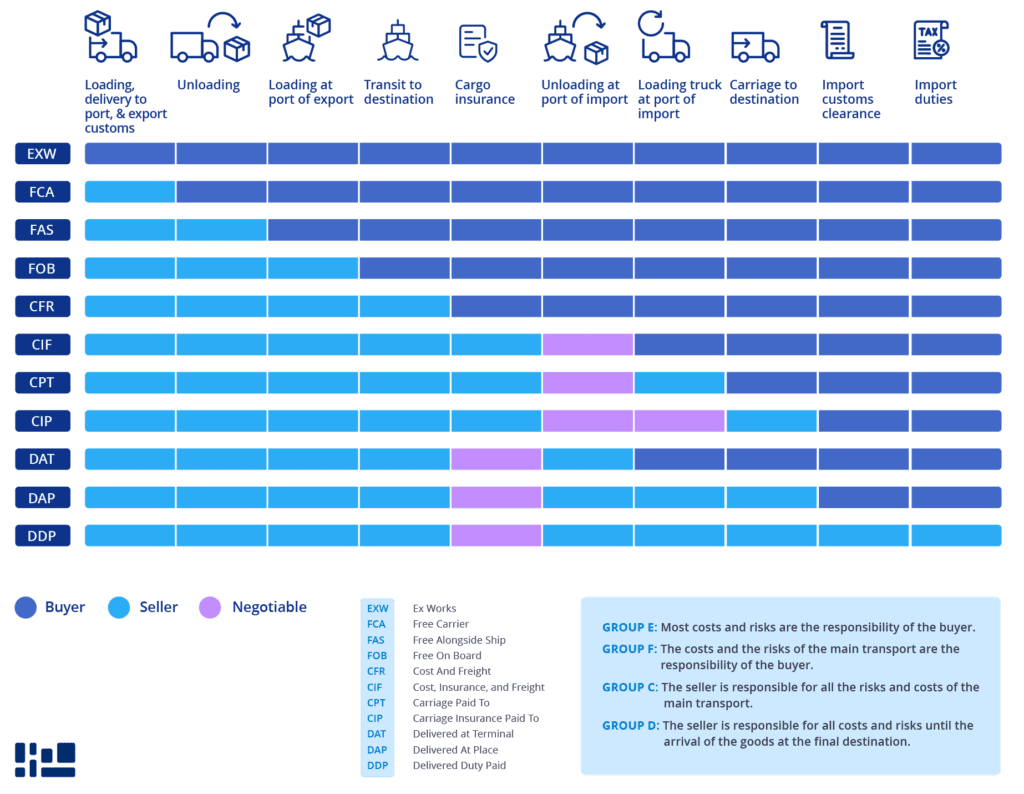
Which Incoterms should I use?
The following are some of the most common incoterms and the circumstances under which they may be chosen: Free On Board (FOB) This common incoterm is for ocean transport only and means that responsibility for the cost is transferred to the buyer once the goods have been loaded “on board” the transport vessel. FOB gives the buyer a high degree of control over the freight forwarding process. Since the buyer chooses his own freight forwarder, he benefits from greater flexibility with respect to costs, terms and shipment planning. ExWorks The ExWorks Incoterm means that the responsibility is transferred to the buyer at the supplier’s warehouse and not on board the vessel. This means that the buyer pays for and is responsible for the transportation of the goods every step of the way, door to door. All the supplier has to do is prepare the goods for collection. This Incoterm gives the buyer full control over freight costs, but it also means that he is responsible for everything that happens in the country of origin, which is usually not his country of residence. More experienced shippers can benefit from the use of this incoterm. FCA (Free Carrier) When FCA is used, the buyer assumes responsibility and costs once the goods have been loaded onto a means of transport or delivered to a specific place agreed upon by the buyer and seller, usually a port. This Incoterm is used for all modes of shipment. With FCA, the supplier is responsible for packing and transportation at origin. This means that the supplier has more responsibility than with ExWorks, but the buyer still bears costs and responsibilities earlier than when using FOB. The above information covers most countries in most circumstances. However, there are some factors to consider when choosing an Incoterm with your supplier:
- Customs procedures are much more relaxed at permeable borders, such as within the EU.
- Countries require different procedures and formalities for shipments: the U.S. requires a customs bond, importing into the U.K. requires a deferral account, and exporting from India includes a withholding tax.
When to challenge recommendations Some forwarders prefer to use only one set of preferred incoterms because they “seem to work”. Therefore, don’t be surprised if some forwarders reject your choice of incoterm, even though it is the most appropriate for your shipment.
What shipping incoterms do not cover
Incoterms do not cover property rights, possible force majeure situations and breach of contract. Include these within the sales contract. Likewise, all incoterms, except the C terms, do not assign the responsibility of contracting insurance. Cargo insurance is therefore a separate cost to buyers. Definition of designated location in the sales contract When the incoterm is written in the sales contract, the designated location should immediately follow the three-letter incoterm abbreviation, e.g., “FCA Shenzen Yantian CFS”. Be precise when defining the location, particularly with larger cities that may have multiple terminals, and with large terminals that may have multiple delivery points. You can use this global port finder to find specific port codes. How letters of credit limit the choice of incoterm If the sale is completed with a letter of credit or documentary letter of credit, the chain that releases the funds begins when the seller provides various documents to the bank, including the bill of lading/airway bill. Letters of credit are used when there is limited trust between the seller and buyer. That rules out EXW, because the supplier will be paid prior to withdrawal. F terms require trust because if the buyer cancels the international transit, the supplier will not have a bill of lading to present to the bank. The D terms require reliance because the seller is responsible for all transportation costs. Therefore, the four C terms are the best options to use with a letter of credit.